Problem Statement
Design a rocket with the capability of launching over 4,000 kg to GTO and 11,000 kg to LEO
_edited.jpg)
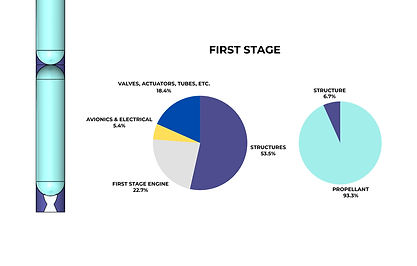
First Stage Design
Stage 1 has a mass fraction of 0.93. It is 3.9m in diameter and is 31.09 m tall. It weighs 336,300 kg and has a takeoff thrust to weight with the GTO payload of 1.28 g’s. This diameter was chosen because it is a relatively standard size among many launch vehicles. The tanks are 4.5mm thick and made out of Al-Li-2195. This composition of alloy is becoming more common for rocket tanks because it is lighter weight. The fuel and oxidizer tanks in the first stage are both vertical capsules.
_edited.jpg)
Second Stage Design
Stage 2 has a mass fraction of 0.94. It is 3.9m in diameter and is 24.6 m tall including the payload fairing. It weighs 62,389 kg and thrust to weight with the GTO payload of 1.39 g’s. It has the same diameter as stage one, reducing the need for complex interstage adapters. The tanks are 3mm thick and made out of Al-Li-2195. The tanks are slightly less thick than the stage one tanks because it has less fuel to carry. The fuel tank is a 2:1 elliptical tank, and the oxidizer tank is a vertical capsule

LEO Mission
The LEO mission is 400 km circular at 45 degrees inclination. The vehicle is capable of carrying 11,760 kg to orbit.

GTO Mission
The GTO mission is 200 x 35786 km at 27 degrees inclination. The vehicle is capable of carrying 4,458 kg to orbit.

Excel vs. STK
The performance estimations for this launch vehicle were compared to an actual mission uisng the same parameters in Ansys STK. For the GTO mission, the required delta V only varied by ~2 m/s. The LEO mission varied by about ~700 m/s. This showed me that doing simple "back of the napkin" type calculations can get you close to an accurate answer.

Ascent Design
For this mission, the altitude at burnout was 200 km, the downrange distance at burnout was 420.1 km, and the inertial burnout velocity was 3.32 km/s. Using these parameters, vacuum impact point properties were calculated. The rocket would impact 1703 km downrange at a speed of 2732 m/s. The total time from burnout to impact is 439.5 seconds.